
Protect your vehicle from E20 corrosion.
Put 5ml before you fill petrol. Stops ethanol rusting your tank and increases your mileage.
Two years of E20 will destroy your fuel tank
Same vehicle, same fuel, same two years. The only difference is one capful before each fill. Drag the timeline.
Illustration of the corrosion mechanism
No country runs ethanol without a detergent.
Brazil learned it over fifty years. America wrote it into a carmaker standard. The molecule they all settled on is PEA, and it is what is in this bottle.
Fifty years of ethanol, now at 30%. Higher than our 20%.
More deposits in a fuel system running without a detergent than with one. 660 mg per valve against 34 mg.
The detergent Chevron patented in 1980. Still the benchmark.
There are two kinds of fuel detergent. We use the expensive one.
Cheap additives use PIBA. It works on an old engine and falls apart in the heat of a modern one, leaving residue of its own. We use PEA, the molecule Chevron patented in 1980 and the benchmark every serious additive is measured against.
It survives the burn
PEA stays stable at combustion-chamber temperatures and burns off clean. The cheaper detergent breaks down in that heat and leaves deposits of its own behind.
It grips the deposit, then dissolves it
One end of the molecule bonds to the carbon and varnish stuck to your injectors. The other end carries it away into the fuel, where it burns off without residue.
It is what the standard is built on
Chevron patented PEA in 1980 and built Techron on it. Forty five years on, it is still the detergent the top-tier fuel standards are written around.
₹8,000/year in parts. Before labour.
That is what E20 corrosion does. Current replacement part prices for a Maruti Swift.
You replace the tank, you do not repair it
Water settles at the bottom of the tank and rusts it through from the inside. Once a tank is pitted there is no fix, only a new one.
Your pump sits in the water
The pump draws from the lowest point of the tank, which is exactly where the water collects. It was never built to run in it.
A service you never used to pay for
Manufacturers now recommend replacing fuel seals and hoses at 20,000 to 30,000 km on E20. At 12,000 km a year, that is a new bill every twenty months.
Fast loss in mileage
Ethanol holds less energy per litre, so E20 gives fewer kilometres per tank. The government confirms 3 to 5% on pre-2023 vehicles. No additive changes that.
Our product protects you, every time you fill
Your tank stops rusting
Leaves a molecular film bonded to the tank walls and steel lines. The acidic water sits on the film instead of on your metal.
The water never settles
Holds the moisture ethanol pulls in as droplets too fine to sink, so it leaves through the engine instead of pooling where your pump draws.
Your seals last their full life
Conditions hoses, O rings and gaskets through the swelling and drying that ethanol puts them through on every tank, so they do not harden and split.
Your throttle response comes back
Detergents clear the tip deposits that distort injector spray, which is what you feel as rough idling and a flat throttle.
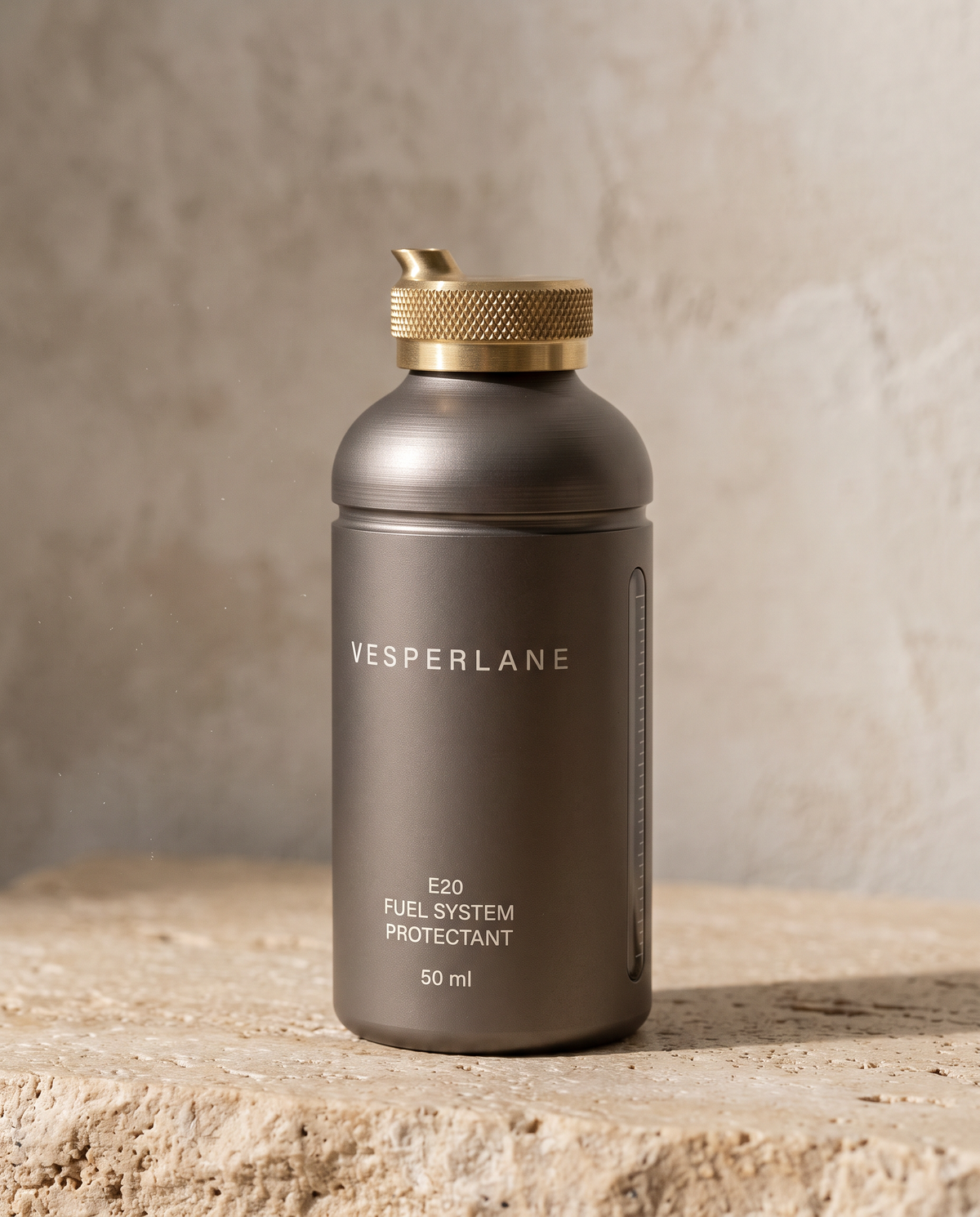
One bottle lasts about six months
You use 5 ml for every 20 litres you fill. A 50 ml bottle treats 200 litres. Set your numbers.
Get it before the next fill
- →Treats 400 litres
- →6,000 km in a car
- →18,000 km on a bike
Straight answers
Pour 5 ml into the tank before you fill, for every 20 litres of petrol. Then fill as normal. No mixing, no waiting.
Yes, petrol engines only. Never put this in a diesel tank.
No. Vehicles built from April 2023 onward are certified for E20 with fuel system materials specified for it. Save your money.